The world's leading manufacturer of precision hardware products
Has decades of rich experience and advanced equipment
2026-07-24 07:33:46
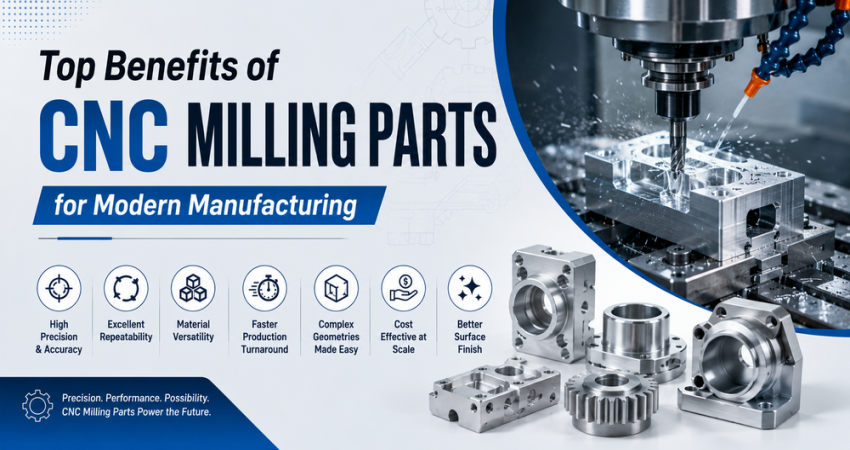
CNC milling has sort of become one of the backbone tools in precision manufacturing, giving many industries a steady way to make intricate, super accurate components in volume. From cars to aerospace, electronics to medical devices, CNC milling parts show up everywhere, especially where tight tolerances and the same quality every time are kind of non-optional. A lot of manufacturers also count on Aluminium CNC Milled Parts for cases where strength plus accuracy and lighter weight construction really matter most. In this piece, we look at the main advantages of CNC milling, why it still remains a go to option for modern output, and how it can lead to cost friendly yet high quality manufacturing.
CNC milling parts are components made on CNC milling machines, using computer numerical control. Rotating cutting tools remove material from a solid workpiece, until you get the exact shape you designed. Unlike casting or melding, milling is more of a subtraction process, you kind of carve out the part from raw metal or plastic stock based on a digital design. That’s a big deal because it helps keep extremely tight tolerances, and it supports consistent accuracy even through huge production runs.
It starts with a CAD model, (computer-aided design). Then that design turns into machine readable code, often called G-code. This code tells the CNC milling machine parts what to do, so the spindle, the cutting tools, and the worktable move across multiple axes. Material comes off layer by layer, until the finished part shows up for real. After machining, the parts can still go through secondary finishing like deburring, anodizing, or polishing, before the final inspection step.
Reliable CNC milling supplier delivers a precision and repeatability level that hand machining usually can’t match. Since the whole process is digitally guided, CNC machined parts can be produced again and again with near identical results, even for thousands of pieces. That’s why CNC milling works for prototyping as well as full scale production. And because it can work with different materials, plastics, metals, and more manufacturers get flexibility across very different industries.
Because CNC milling is both precise and flexible, it shows up in lots of industries, like
CNC milling parts really do bring a bunch of advantages to modern manufacturing, precision repeatability and that material flexibility, plus cost control, it all adds up. Because of that CNC milling is used a lot for making components in many fields, automotive one year, medical devices another, you know. And when a company leans into CNC milling, they can be sure the output hits high quality, and keeps performance where it should be, all while still having a production workflow that feels efficient, scalable, and dependable. If you need a solid manufacturing partner, pshardware.com is there with CNC milling services, including aluminum and stainless-steel machining, so precision parts get from design to reality.
Frequently Asked Questions (FAQs)
1. What are CNC milling parts
CNC milling parts are precision components made with computer-controlled milling machines, they remove material to form accurate shapes, mostly for tight fit requirements.
2. What materials can be used for CNC milling
Typical options include aluminum, stainless steel, brass, copper, titanium, carbon steel, and also engineering plastics.
3. Why are Aluminum CNC Milling Parts popular
They are light in weight, resist corrosion well, they’re easy to machine, and they bring a great strength to weight ratio, which makes sense for many product designs.
4. Where are CNC Machined Parts commonly used
You see them all over, automotive, aerospace, medical, electronics, industrial machinery, and robotics, basically any place where tolerances matter.
5. How do I choose a reliable CNC milling supplier
Try to check for real experience, advanced equipment quality certifications, technical know-how, and proof that they consistently deliver accurate precision parts.
6. Can CNC milling produce custom components
Yes, CNC milling is well suited for custom parts with intricate geometry and strict tolerances, so designs don’t have to be “simplified” too much.
7. What is the difference between CNC milling and manual machining
CNC milling is computer-driven, so you get steadier precision repeatability and efficiency. Manual machining is more dependent on the operator skills, and in general it runs slower, even if a skilled person can still achieve good results.
Date : 22 Jul 2026
Date : 15 Jul 2026
Date : 30 Jun 2026

Date : 25 Jun 2026
Date : 22 Jun 2026
Date : 18 Jun 2026