
The world's leading manufacturer of precision hardware products
Has decades of rich experience and advanced equipment
2026-06-30 01:37:33
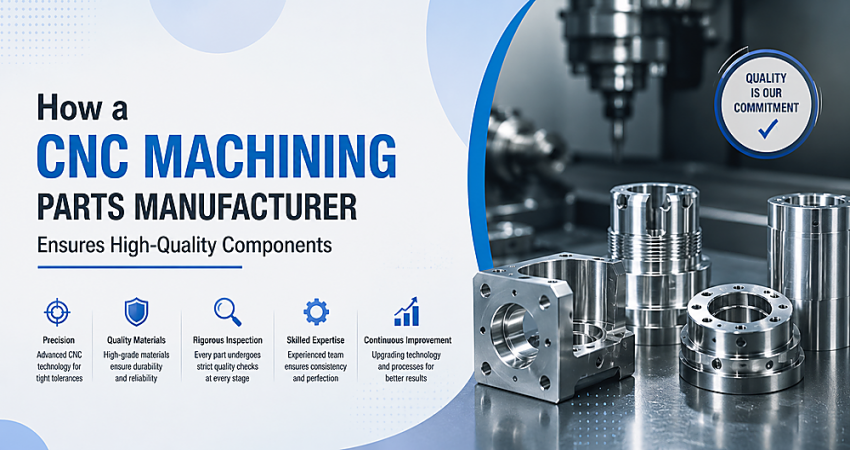
Quality is kind of the one biggest factor that separates a dependable CNC Machining Parts Manufacturer from one that just runs machines and hopes. In industries like automotive, aerospace, electronics, and industrial equipment, even a 0.01 mm deviation can end up meaning the difference between a part that fits like it should and one that fails out in the field. so, every step of production — from that first CAD file, to the final inspection report — is built around consistency, accuracy, and repeatability. This article gives you a clear breakdown of how manufacturers reach High-Quality CNC Components, what processes and checks they use, and what you should look for when sourcing parts for your next project. And if you are already checking suppliers, you can also Buy CNC milling & machining Housing online directly, instead of getting stuck in those slow procurement cycles.
A reliable manufacturer doesn’t only have CNC machines. They pair skilled engineers, validated processes, and strict documentation so that each batch matches the design intent. Reliability basically comes from three things working together: the right equipment, the right people, and a quality system that catches errors before they turn into defects. When those parts align, the result is that they can produce CNC Machined Components at scale, without losing accuracy along the way.
1. Precision Engineering and Tight Tolerances
Precision CNC machining is basically how well a manufacturer controls tolerances in real life. New CNC machines might be able to hold ±0.005 mm, but doing that again and again means more than just “good hardware”. Engineers use advanced CAD/CAM programming to convert design requirements into machine instructions that are actually consistent, and calibrated cutting tools plus rigid machine bases help prevent drift during long production runs. Temperature control matters too, because heat buildup can make materials expand slightly, and then the dimensions can miss the target if it’s ignored.
2. Smart Material Selection for Custom CNC Machining Parts
Material choice affects strength, weight, corrosion resistance, and how easily it machines. A manufacturer handling Custom CNC Machining Parts usually helps pick a material tied to the application — aluminum for light structural parts, stainless steel for corrosion resistance and strength, brass for electrical conductivity, or engineering plastics like POM and PEEK for low-friction use, or high-temperature settings. If you choose the wrong material, you might see premature tool wear, weird dimensional behaviour, or even total part failure, so this isn’t treated like some side note.
3. Advanced Machine Tools and Automation
Multi-axis CNC machines, automatic tool changers, and high-speed spindles make it possible to machine complicated shapes in a single setup. That means the part gets repositioned fewer times. Fewer setups usually mean fewer opportunities for human error, and tighter consistency from one unit to the next. Automation also accelerates repetitive operations like drilling, tapping, and facing, so lead times stay short while accuracy remains intact — which is honestly a core expectation for any serious CNC Manufacturing Services provider.
4. Strict In-Process and Final Quality Control
Quality control isn’t only some “end-of-line” thing. It’s woven into each stage. During production, in-process inspections help catch dimensional drift early. Then, finished parts get validated using tools such as Coordinate Measuring Machines (CMM), surface roughness testers, and laser scanners to confirm the final result matches the original specification. A lot of manufacturers also run under ISO 9001, or a similar quality management standard, which means there must be documented inspection records for every batch. That layered method is what makes output dependable, rather than merely “okay”.
5. Skilled Engineering Teams and Clear Documentation
Machines execute instructions, but engineers and machinists decide what those instructions should actually be. Skilled teams know how to streamline tool paths, anticipate material behavior, and resolve problems before a production run is fully affected. Clear work orders, revision-controlled drawings, and traceability records mean that if a customer reorders the same part six months later, it should show up basically identical to the first batch.
6. Scalable, Cost-Effective CNC Manufacturing Services
A good manufacturer doesn’t force you to pick between affordability and quality. Better nesting of raw stock, optimized cycle times, and batch planning can reduce material waste and labor cost without skipping inspections or tolerances. This matters a lot for companies that need to go from small prototype batches to large volumes. If you need parts at scale without sacrificing the finish or fit, you can buy CNC aluminum machined & milled online, and still expect consistent results whether you’re ordering ten pieces or ten thousand
Working with an experienced manufacturer tends to bring more than just "getting the part made." You get repeatability that actually holds up, even on larger runs. Turnaround can feel faster too, because most of the steps are already dialed in and optimized. And rejected parts go down, since quality checks are usually built right into the process instead of being tacked on at the end, like an afterthought. You also gain access to engineering input — a solid manufacturing partner will call out design concerns, sharp internal corners or tolerances that don’t make sense, before they turn into expensive mistakes.
Because of accuracy and material flexibility, CNC machined components show up almost everywhere precision is not negotiable. In automotive, CNC Machined Components often show up as engine brackets, housings, and transmission parts. In electronics, they’re used for enclosures, heat sinks, and those connector housings that need to line up just right. Industrial equipment makers lean on CNC parts for gearboxes, fixtures, and structural assemblies, while medical device teams depend on tightly toleranced parts for instruments and equipment housings. Across all of these, the real expectation is the same: components that fit properly the first time, every time… no drama.
High-quality CNC components don’t happen by accident, they’re usually the result of precise engineering, careful material selection, advanced equipment, and strict quality control, all working together across every stage of production. Whether you are sourcing a single prototype, or planning a high-volume production run, partnering with a CNC Machining Parts Manufacturer you can trust makes the difference between parts that just look right, and parts that perform reliably for years. pshardware.com brings together this mix of precision, material know-how, and scalable production so you get consistent, high-quality components across industries. If you are trying to Buy Aluminium CNC Milled Parts online for a new product line, or you need to Buy Metal stamping parts 3 alongside your CNC components, pshardware.com gives an easy path to source custom-machined parts without the usual procurement delays.
1. What does a CNC Machining Parts Manufacturer do?
A CNC Machining Parts Manufacturer designs and manufactures precision-engineered components, using computer-controlled machines, for automotive, aerospace, electronics, medical, and industrial equipment.
2. Why is Precision CNC Machining important?
Precision CNC Machining helps hold tight tolerances, accurate dimensions, consistent finishes, and stable production quality, so components can be counted on in real applications.
3. What are CNC Machined Components?
CNC Machined Components are precision parts made with automated CNC machines, to achieve strong accuracy and repeatability.
4. Which materials are commonly used for Custom CNC Machining Parts?
Common options include aluminum, stainless steel, brass, copper, titanium, carbon steel, mild steel, and engineering plastics, depending on what the part is meant to do.
5. How do manufacturers ensure High-Quality CNC Components?
They usually use premium raw materials, advanced CNC machines, CAD/CAM software, experienced engineers, precision measuring tools, and multiple quality checks during production.
6. What industries use CNC Manufacturing Services?
Automotive, aerospace, defense, medical, electronics, robotics, construction, industrial machinery, and energy sectors all rely on professional CNC Manufacturing Services.
7. What are the advantages of Custom CNC Machining Parts?
They typically offer tighter accuracy, improved performance, custom geometry, fewer assembly headaches, better durability, and often cost-effective production.
8. How do I choose the right CNC Machining Parts Manufacturer?
Go with a manufacturer that has modern CNC equipment, experienced engineers, rigorous quality control procedures, customization options, international quality certifications, and a solid history of delivering precision-engineered components.

Date : 25 Jun 2026
Date : 22 Jun 2026
Date : 18 Jun 2026
Date : 11 Jun 2026
Date : 29 May 2026
Date : 25 May 2026