
The world's leading manufacturer of precision hardware products
Has decades of rich experience and advanced equipment
2026-06-22 08:21:58
In the modern manufacturing industries, the requirement for mechanical components is very high for their precision, consistency and efficiency. Manufacturers need to have highly accurate parts to guarantee the performance and dependability of their products, from aerospace and automotive systems to medical devices and electronics. Among the most modern techniques of manufacturing today, Swiss turning is a type of turning operation specialized on manufacturing complex shapes and components with a high level of precision and accuracy. With the precision parts' quality and reliability, many companies are opting to buy Swiss Turning Parts online, as they continue to look for quality pieces for their industries. For example, the Buy Stainless steel 316 turning shafts online process involves complex turning techniques to ensure that the parts produced meet the high demands of industries. Businesses can make better decisions about the precision-engineered components they choose, by understanding what Swiss turning parts are and how they are manufactured.
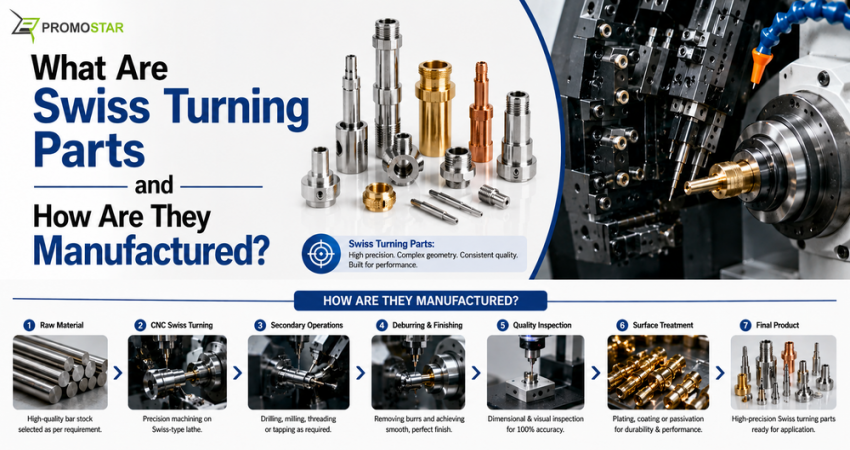
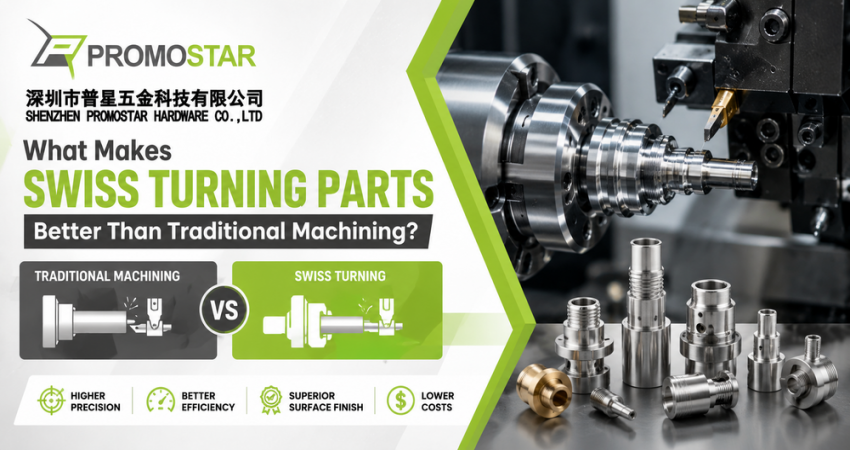
Swiss turning parts are precision parts made by Swiss type CNC lathe. The Swiss lathes use a guide bushing to hold the part against the cutting tool, in contrast to conventional lathes which hold the part farther away from the cutting tool. The special design produces a marked reduction in vibration and enables very accurate machining of very small and complex parts.
Swiss turning parts are commonly used in:
It is particularly well suited to the manufacture of small diameter components with high precision and repeatability. These products are often used in addition to Swiss-machined components to assemble complete industrial assemblies that meet modern manufacturing requirements.
The difference between Swiss turning and conventional turning is the way the material is secured for the cutting operation. Traditional turning has the work piece projecting further from the chuck on the machine which may result in vibration and inaccurate machining of smaller parts.
With Swiss turning, it is the guide bushing that holds the material close to the point of cut. This arrangement has a number of benefits:
Due to these advantages, it's very common for many manufacturers to order Swiss Turning Parts online when accuracy and reliability are critical.
So the Swiss turning manufacturing process starts when a metal bar is fed through a guide bushing, and the CNC machine takes over from there. Basically, it controls the movement of the workpiece and the cutting tools, with this really consistent precision. It’s not just about one step though, it’s a chain of stages that sort of builds on each other.
Usually the process includes several stages like this:
This process also gives things like:
And honestly in the middle of many industrial manufacturing projects, companies will also look for items like Buy Precision turning stainless steel online, because precision-machined stainless steel components bring good strength and solid resistance to corrosion. All those traits make Swiss turning a very fitting approach for demanding engineering tasks, even when the requirements are strict.
Swiss turning is used pretty often in lots of different industries, mainly because it can make super accurate components. It’s sort of flexible too, in a way that helps with tighter tolerances, and the results stay stable.
Overall, the adaptability of Swiss turning helps manufacturers handle what each industry actually asks for, without needing to compromise too much.
In the present trend towards miniaturization, lightness and accuracy, Swiss turning is gaining ever greater significance in industry. Its capacity for producing very complex components with a very high level of accuracy is a key enabling technology in modern engineering. Australian businesses often prefer Swiss Turning Parts suppliers with Swiss machining technology as it guarantees superior quality and performance in the long term. In many cases, these products are combined with Swiss-machined parts to form a whole industrial product which can satisfy the requirements of modern manufacturing.
Swiss turning parts for sale are really among the most precise and dependable components used in today’s manufacturing industry. They can hit tight tolerances, give a smoother surface, and keep output consistent in a way that is almost hard to beat, which is why they are so useful when accuracy matters a lot. From aerospace and medical devices to automotive and electronics production, Swiss turning technology keeps showing up as a key method for building high performance components. And as industries keep asking for more complex, more smart products, Swiss turning still feels like one of the more advanced and efficient machining solutions on the market. For top tier precision engineered components and modern machining solutions, pshardware.com has a broad selection of products made to support current industrial, and manufacturing needs too.
1. What are Swiss turning parts?
Swiss turning parts are precision-machined components made using Swiss-type CNC lathes, created for high accuracy, and tight tolerances.
2. Why is Swiss turning more accurate than traditional turning?
The guide bushing supports the workpiece nearer to the cutting tool, which helps reduce vibration, and boosts machining stability.
3. What materials can be used in Swiss turning?
Common choices include stainless steel, aluminum, brass, titanium, copper alloys, and engineering plastics, depending on the application.
4. Which industries use Swiss turning parts?
Aerospace, medical, automotive, electronics, and industrial manufacturing environments often lean on Swiss turning components.
5. Are Swiss turning parts suitable for high-volume production?
Yes. Swiss turning is efficient, and it works well for both short runs, and high-volume production, even when deadlines are tight.
6. What are the benefits of Swiss turning?
The main strengths are high precision, improved surface finish, less material scrap, and stable production quality.
7. Can Swiss be turning produce complex components?
Yes, Swiss machines can fabricate intricate parts with lots of tiny detail, while still keeping accuracy strong.
8. How are Swiss turning parts inspected for quality?
Most manufacturers rely on precision measuring instruments and quality control steps to verify dimensions, tolerances and surface finishes.
Date : 30 Jun 2026

Date : 25 Jun 2026
Date : 18 Jun 2026
Date : 11 Jun 2026
Date : 29 May 2026
Date : 25 May 2026